The Feminine Urge to Be Vulnerable
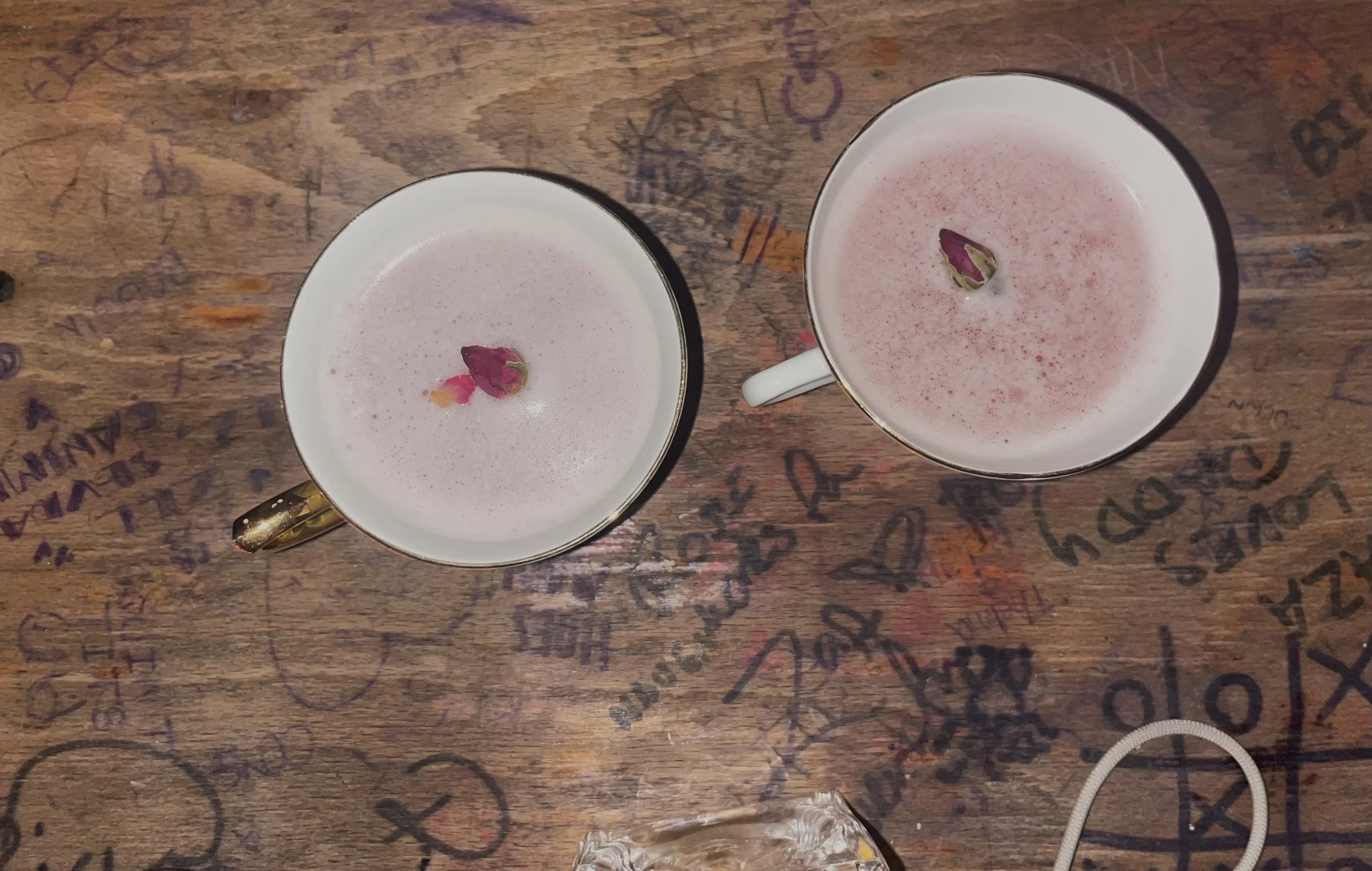
What if I had a white wall? A clean slate? What if I could just start again - turn away from my wall with its mismatched framed paintings, its peeling paint and the patch of damp I’ve been hiding behind a poster for years.
I look over at the walls of the people I admire, and theirs seem immaculate: bone-white, smooth, perfectly spaced prints measured out like they’re following some unspoken rule. Just enough space for less. Just enough space for more.
Yet no matter how much paint I lay on, my wall is never quite that bright. No matter how many times I air the room, the damp persists. No matter how carefully I adjust the frames, they still tilt or fall.
We all have a wall – the backdrop against which every new moment unfolds. Built from what has happened to us and what we have made happen. One large mosaic of our life whether we like the pattern or not.
When we feel vulnerable, this wall can become something we hide. A tapestry can cover it - light, lovely, seemingly effortless. Just enough to disguise the mess behind. When people come into your home, they don’t see your wall at all.
They admire this piece of fabric: Oh, what a beautiful tapestry, where did you get it?
You get to say: I made it. Rather than confess, it’s covering what I am scared for you to see.
I feel that when I wear my boots - disguised, protected, armoured for the day. When we’re in pain, it’s easy to confuse feeling bigger, stronger, more untouchable with healing. But usually, it’s just an attempt to regain footing, to feel less at the mercy of whatever hurt us.
This past month has pushed that instinct to its limits. My heart has been tired in the way that makes everything else feel tired too – even my hands, which is why this blog is late. When I am hurting, something in me almost rushes toward the tapestry. My defences become exciting, sparkling with familiarity. A bigger smile, more mascara, the gym at ridiculous hours – in the hope that a wound could be a new chance to outrun myself, sprinting toward the ‘ideal’ version of me – as if distance from the hurt is the same as healing.
Judith Butler, the American philosopher, argues that identity is ‘always a doing’: a performance shaped by culture and history. Through the wall metaphor, that performance becomes the tapestry – a carefully chosen image obscuring the uneven surface beneath. Butler also helps explain why the tapestry becomes most appealing when we’re vulnerable: many of us learned young to be palatable, composed, or non-disruptive even when distressed. Silence, over-smiling, reassurance offered when reassurance is what we lack – these aren’t random habits, they are learned strategies for maintaining a perceived acceptable version of the self.
This is not an argument for radical exposure, nor an invitation to tear down every form of self-protection. It is an encouragement to notice the choreography: which parts of ourselves we allow to be visible when we’re in pain, which cracks we conceal, and what we refuse to acknowledge at all.
There is another thing the wall teaches us – something less glamourous than the performance and infinitely harder to practice: carrying the pain while still moving through the world.
Emotional pain adds a patina to the wall, a kind of weight. Trying to live your ordinary life while hurting can feel like pushing that wall with your bare hands – speaking to people you won’t spill your heart to, drafting the long report, sitting through meetings, even getting from one place to another. Everything moves slower. Everything takes more from you than it usually does. I’m writing this from the library, pausing every few sentences. Even my hands feel tired.
This is what emotional exhaustion does: it reduces our capacity for ‘normal’. The present becomes harder to stay in; the ‘what ifs’ become easier to hear. And still, strangely, this is where the wall becomes useful again – not because it shields us, but because it gives us something to lean on.
Psychologist Xianwei Che and colleagues found that when people speak about distress in the presence of someone supportive, the brain’s threat response literally calms. The amygdala – the alarm system – quiets down. Pain becomes more tolerable. Humans aren’t built for solitary regulation; our nervous systems outsource safety to connection.
Sharing is not a liability. It is a biological strategy.
There is a second layer that has helped me: research by George Bonanno shows that when adversity disrupts our internal world – our beliefs, goals, sense of purpose – distress emerges. But meaning-making helps bridge that rupture. It allows us to integrate the experience into a larger story rather than merely endure it.
This is where performance and meaning diverge. Performance hides the wall. Meaning-making lets us live with it.
Meaning doesn’t require turning heartbreak into masterpiece or trauma into triumph. Sometimes it looks like something much quieter: treating the coursework, the training session, the meeting as proof that you are still moving, still learning, still becoming.
This integration lets us inhabit both pain and process. We don’t have to endure pain by outpacing it or performing through it.
The tapestry can manage impressions, but it cannot sustain intimacy or connection. To be known requires the wall itself - the unedited material of experience.